Service Dog Tasks and the Public Access Test, Explained
This page explains the law in general terms. It is not legal advice. For a specific situation, contact the agency listed on this site or an attorney.
Two questions come up again and again for people training a service dog in Vermont. What tasks can a service dog do that actually count under the law? And what is a public access test, and do you have to pass one?
This guide answers both. It walks through how to identify and teach a real task, then how to use a public access test as a practical benchmark for training. The test is a training tool. It is not a legal requirement under the ADA.
The short version
- ADA.gov says a service animal is a dog individually trained to do work or perform tasks for an individual with a disability.
- A task must be directly related to the person's disability. Comfort from the dog's presence alone does not meet that definition.
- A public access test is a training benchmark. Assistance Dogs International (ADI) programs use this kind of standard. The ADA does not require a team to pass one, and it requires no certificate or registration.
- Vermont's public accommodations law, 9 V.S.A. section 4502(b), bars places of public accommodation from prohibiting entry to a person with a disability accompanied by a service animal.
For the broader legal picture, see our guide to service dogs in Vermont, including training, access rights and where they apply.
What counts as a task under the ADA
The ADA.gov service animal FAQ draws a clear line. A service dog does work or performs tasks for a person with a disability. The work or task must be directly related to that person's disability.
That wording matters. A dog that is calm, friendly and loved by its handler is a wonderful companion. But under the ADA, that alone is not a task.
Examples of tasks, by type of disability
ADA.gov gives examples of the kinds of work service dogs do. The examples below follow that guidance. Every team is different, so these show the range and are not a complete list.
- Vision disability: guiding a person around obstacles and stopping at curbs or steps.
- Hearing disability: alerting the person to sounds such as a doorbell, alarm or someone calling their name.
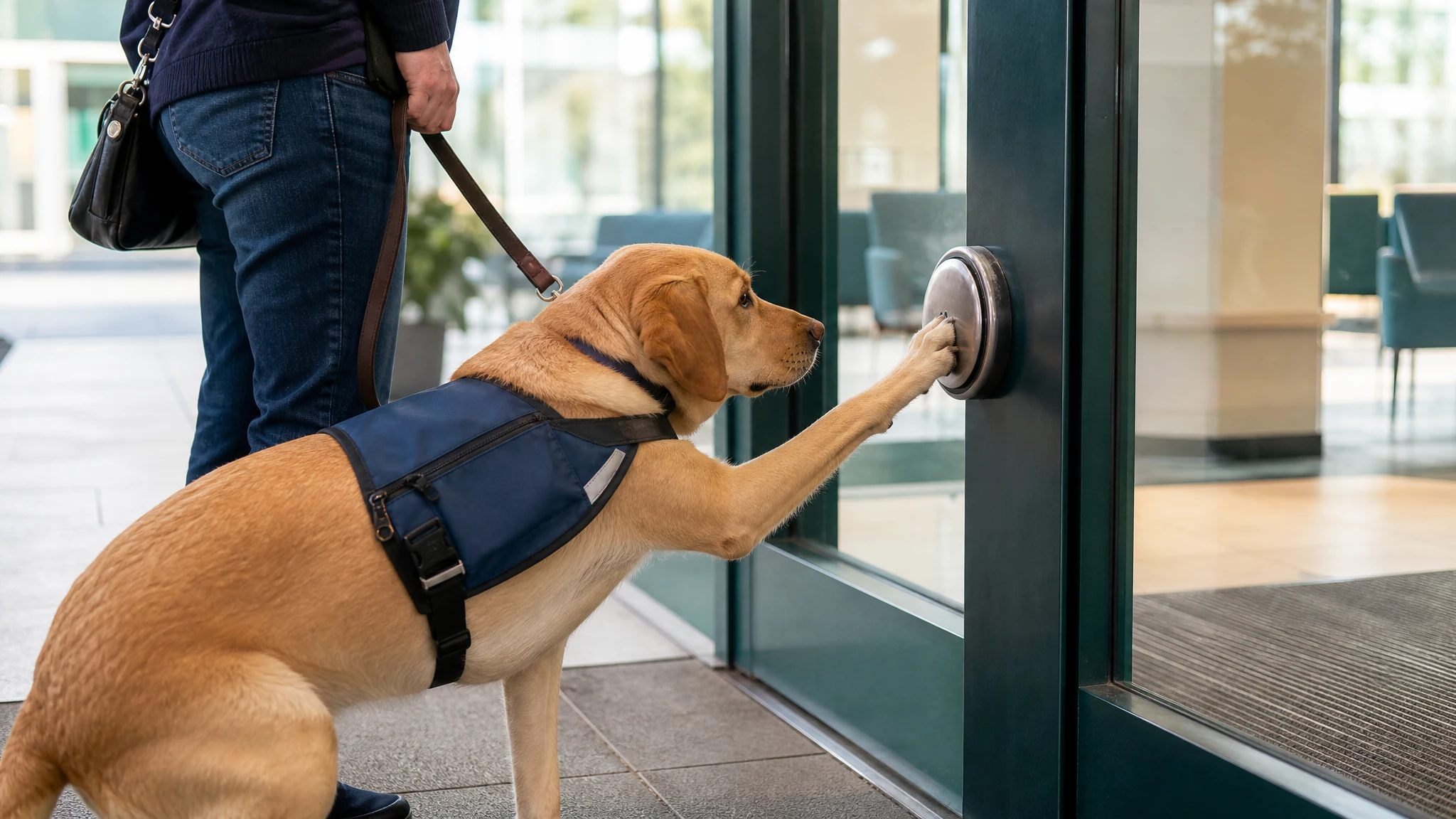
- Mobility disability: retrieving dropped items, opening or closing doors, or pulling a manual wheelchair.
- Seizure disorder: alerting to a seizure or staying with and protecting the person during one.
- Diabetes or other medical conditions: alerting the person to a change that needs attention, or fetching medication.
- Psychiatric disability, including PTSD: interrupting a harmful behavior, or performing a trained action to help a person during an anxiety episode.
Each of these is something the dog does in response to a cue or a trigger, and each is tied to a limit caused by the disability. That link is what makes it a task.
Why comfort alone is not a task
ADA.gov says that emotional support, therapy and comfort animals are not service animals under the ADA. It also says the crime deterrent effect of a dog's presence, and the comfort a dog gives simply by being there, do not qualify as work or tasks.
The difference is between being and doing. A dog that sits near someone who feels better for it is giving comfort. A dog trained to press on a person's chest on cue during a panic episode, or to turn on lights and check a room, is performing a task.
None of this belittles emotional support. It only keeps the federal definition exact, and that exactness protects the rights of everyone with a service dog.
Materials you will need
- A written list of the specific limits your disability creates and the tasks that could help with each one.
- A flat buckle collar or a well-fitted harness. Choose gear that fits your dog and your needs.
- A standard leash, and a long line for early distance work.
- Small, soft treats and, if your dog likes them, a favorite toy as a reward.
- A training log (a notebook or a phone note) to record dates, places and results.
- A clicker or a verbal marker word, if you use marker training.
- A trusted, reward-based trainer or program, if you want coaching. Check any program's methods before you commit.
Step-by-step: building a task and testing it in public
Step 1: Name the task and its link to your disability
Write one sentence for each task: "When X happens, my dog does Y, which helps me with Z." If you cannot fill in Z with something connected to your disability, rethink the task.
This sentence also prepares you for the second question staff may ask. ADA.gov says staff may ask only two things: is the dog a service animal required because of a disability, and what work or task has the dog been trained to perform? Having a clear, short answer makes those moments easier.
Step 2: Teach the behavior with rewards
Break the task into small pieces. For a retrieve, that might be looking at the object, touching it, picking it up, holding it, then bringing it to your hand.
Mark and reward each small success. The American Veterinary Society of Animal Behavior (AVSAB) supports reward-based training. Do not use shock, prong or choke collars, and do not use alpha rolls, scruffing or any dominance method. They can damage trust, and they work against the calm, willing attitude a service dog needs.
Step 3: Attach a cue or a trigger
Once the dog does the behavior reliably, link it to a cue, such as a word or hand signal, or to a trigger, such as a sound or a change in your body. Some alert tasks are learned from scent or behavior and need expert guidance. A reward-based trainer or program can help you with these.
Step 4: Practice in new places
Dogs do not generalize well. A retrieve that works in the kitchen may fall apart in a hallway. Practice each task in several rooms, then outside, then in quiet public spaces, and add distractions slowly.
Step 5: Build the public manners that support the task
A task is only useful if the dog can work reliably around people, noise and food. Foundational skills include:
- Walking on a loose leash without pulling.
- Settling under a table or beside a chair for long periods.
- Ignoring dropped food and passing dogs and people.
- Staying calm during door openings, elevators and crowds.
- Coming when called, even with distractions.
- Toileting on cue, so outings stay predictable.
Step 6: Use a public access test as a benchmark
A public access test checks how a dog and handler perform together in realistic public settings. Assistance Dogs International (ADI), the organization that sets standards for many assistance dog programs, uses this kind of test. Many trainers use a similar checklist for their own teams.
It is a training benchmark. The ADA does not require a service dog team to take or pass a public access test, and ADA.gov does not require any certification. If you want to use ADI's current test items, check with ADI or an ADI member program for the official version rather than relying on a summary.
You can still run your own practice version. A typical session might include:
- Entering a store calmly, on a loose leash, and staying close to you.
- Walking through aisles past carts, strollers and other shoppers.
- Resting quietly while you shop, wait in line or sit at a table.
- Ignoring food on the floor and people who call or reach for the dog.
- Staying calm around a sudden noise, such as a dropped item.
- Performing one or more of your trained tasks on cue, even with distractions.
- Exiting and loading into a vehicle without pulling or jumping.
Have a friend watch and take notes, or ask a trainer to observe. Record what went well and what needs more work.
Step 7: Repeat, and retire the dog from work if needed
Run your practice test several times in different places. If the dog is stressed, distracted or unsafe, go back a step. Under the ADA, a handler must keep a service animal under control. ADA.gov also explains that a business may ask that a dog be removed if it is out of control and the handler does not take effective action, or if it is not housebroken.
Sometimes a dog, however well loved, is not suited to public work. Recognizing that early is kind to the dog and to you.
Vermont law and training in public
Vermont's public accommodations statute, 9 V.S.A. section 4502(b), says owners and operators of places of public accommodation, and their employees or agents, may not prohibit entry to an individual with a disability accompanied by a service animal. The text of the statute does not state a harness, ID or handler conduct requirement.
Section 4502(b)(2) also covers a person who is training an animal to perform as a service animal for an individual with a disability. The statute as published does not limit that to professional trainers. That is useful for practice outings, though you should still keep your dog under control and be considerate of others.
Vermont does not appear to run a state service dog ID program. For federal rights, use the ADA definition, which applies to dogs. If you have a question about a species other than a dog, check the statute text or ask the Vermont Human Rights Commission.
If you are denied access
The Vermont Human Rights Commission takes complaints about public accommodations, housing and state government employment. Its address is 12 Baldwin Street, Montpelier, VT 05633. You can call 802-828-2480, email [email protected], or visit hrc.vermont.gov. Under 9 V.S.A. section 4506(a), a person who has been harmed may also file with the Commission or sue in Superior Court. This is general information, not legal advice.
Tips and common mistakes
Tips
- Train one task at a time, and keep sessions short and upbeat.
- Choose rewards the dog loves, and pay well in hard places.
- Practice "nothing" as much as tasks. Calm settling is a skill.
- Log every outing so you can see progress over weeks, not days.
- Look into a Vermont program if you want structured help. Vermont Paws & Boots in Bennington partners rescue dogs with veterans and first responders. Check its site, vermontpawsandboots.org, for who it serves and how to apply.
Common mistakes
- Counting comfort as a task. If the dog is only present, the ADA does not treat that as a task.
- Buying a vest, ID card or online registration as "proof." There is no official service dog registry or required certification under the ADA, and an online registration is not legal proof of anything. Do not spend money on one.
- Skipping distraction training. A dog that works at home may struggle in a busy store.
- Using harsh tools. Aversive methods can raise stress and hurt reliability. Stay with reward-based training.
- Treating the public access test as a legal hurdle. It is a benchmark for your own readiness. Nobody can lawfully demand it as a condition of entry under the ADA.
- Pushing a stressed dog. Signs of stress mean the dog needs a break or a slower plan.
What to expect
Results vary with the dog's temperament, the handler's consistency and the complexity of the tasks. Many teams find that simple tasks can take weeks of regular practice, while reliable public behavior and more complex tasks often take months or longer. Some dogs may not be a good fit for public work.
With steady, reward-based practice, a dog may become more reliable in public, and a handler may become more confident answering access questions. Neither outcome is certain. A practice test can show you where your team is strong and where it may need more help.
Quick recap
- Define each task and tie it to your disability.
- Teach it with rewards in small steps.
- Add a cue or trigger.
- Practice in new places.
- Build calm public manners.
- Use a public access test as a benchmark, not a legal requirement.
- Repeat and adjust, and be honest about the dog's fit for the work.